
A severe hay fever season: record pollen levels and a birch pollen peak on the way
March 2026
Pollen counts from Elkerliek Hospital and Leiden University Medical Center (LUMC) indicate that 2026 is an exceptional year in terms of pollen concentrations in the air.
This year, the pollen season started extremely early with hazel pollen. Shortly thereafter, there was a peak in alder pollen levels that had never been recorded at such high levels before.
Last week, another striking development emerged: ash pollen levels were exceptionally high. Such high levels have never before been recorded for the month of March. This makes the season exceptionally intense so far.
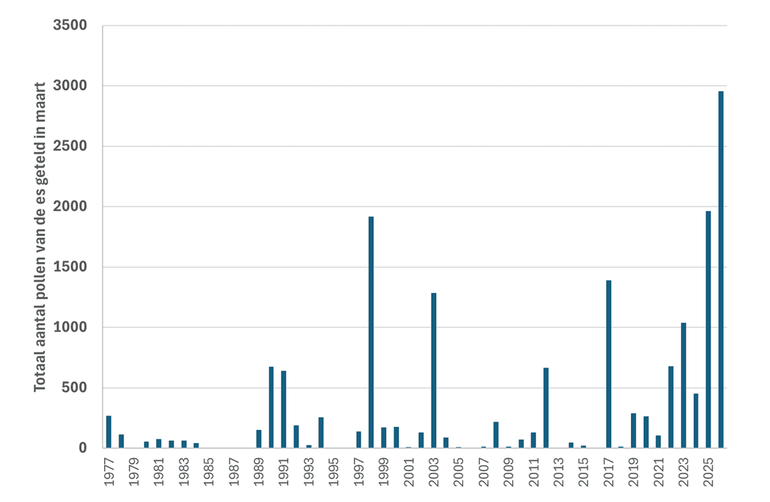
Total number of ash tree pollen grains counted in March by the LUMC from 1977 through 2026 (Source: LUMC)
Birch trees are also expected to start blooming soon. This is the main cause of hay fever symptoms: about 50% of hay fever sufferers are sensitive to birch pollen. As a result, symptoms may worsen for many people in the coming weeks.
The fact that so many pollen records are being broken this year is likely no coincidence. Climate change and air pollution may play a significant role in this. These factors can cause plants to bloom earlier and produce more pollen, leading to higher concentrations in the air.
See also the NOS news report featuring GoHot member Anne Overduin-De Vries of the LUMC and the news article on NatureToday.