
Planting allergy-friendly trees with the Tree Compass
June 2026
The choice of tree is becoming increasingly important as climate change leads to hotter weather and longer pollen seasons
Europe is increasingly facing higher temperatures, prolonged heat waves, and growing pressure on urban livability. Trees play a crucial role in cooling the urban environment, improving air quality, and enhancing biodiversity. However, not all trees have exclusively positive effects. Some species produce large amounts of allergenic pollen that can cause health problems for many people.
Researchers from the GoHot project have therefore developed a new, scientifically grounded Tree Compass : a tool that helps municipalities, landscape architects, and park managers make decisions about urban planting.
Pollen allergies as a consideration in greening initiatives
For people who are sensitive to pollen, tree species such as birch, alder, and hazel can cause symptoms like sneezing, a stuffy nose, watery eyes, and breathing difficulties. These symptoms are often accompanied by fatigue, sleep problems, and difficulty concentrating, which can have a significant impact on daily life.
According to the researchers, these health effects are often not taken sufficiently into account when designing green cities. This leads to situations in which residents call for the removal of trees that cause severe allergic reactions. However, removing trees is undesirable from both an ecological and a climate perspective.
Scientific basis
The Tree Allergy Guide combines international scientific literature with more than fifty years of Dutch pollen data and medical records from hundreds of allergy patients. Based on this information, tree species are classified into five categories, ranging from low to highly allergenic.
The analysis shows that species from the birch family (Betulaceae), including birch, alder, and hazel, are primarily responsible for high pollen concentrations and many allergic reactions. Oak, ash, and some cypresses can also play a significant role.
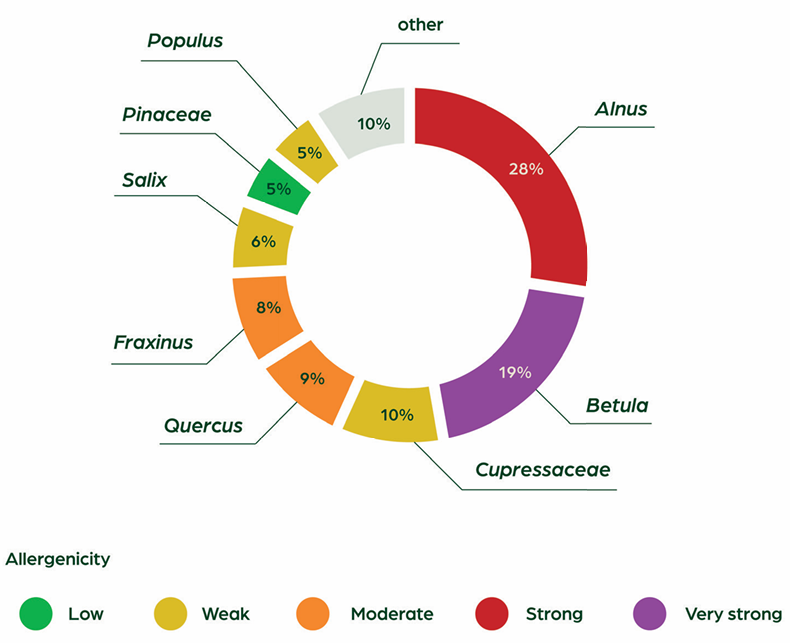
The most common tree pollens counted at Leiden University Medical Center (LUMC) and their allergenicity. Source: https://www.trees.org.uk/News-Blog/Latest-News/Implementing-allergy-friendly-tree-planting
Not fewer trees, but smarter tree choices
The Tree Compass is not a list of undesirable tree species. On the contrary, its purpose is to preserve the benefits of urban greenery while minimizing health risks.
Practical solutions include:
greater diversity in tree species;
avoiding large numbers of highly allergenic trees in a single location;
take into account sensitive locations such as schools and healthcare facilities;
select female individuals of dioecious species, which do not produce pollen;
make greater use of insect-pollinated species instead of wind-pollinated trees.
Greater species diversity not only reduces pollen-related problems, but also enhances biodiversity and the climate resilience of cities.
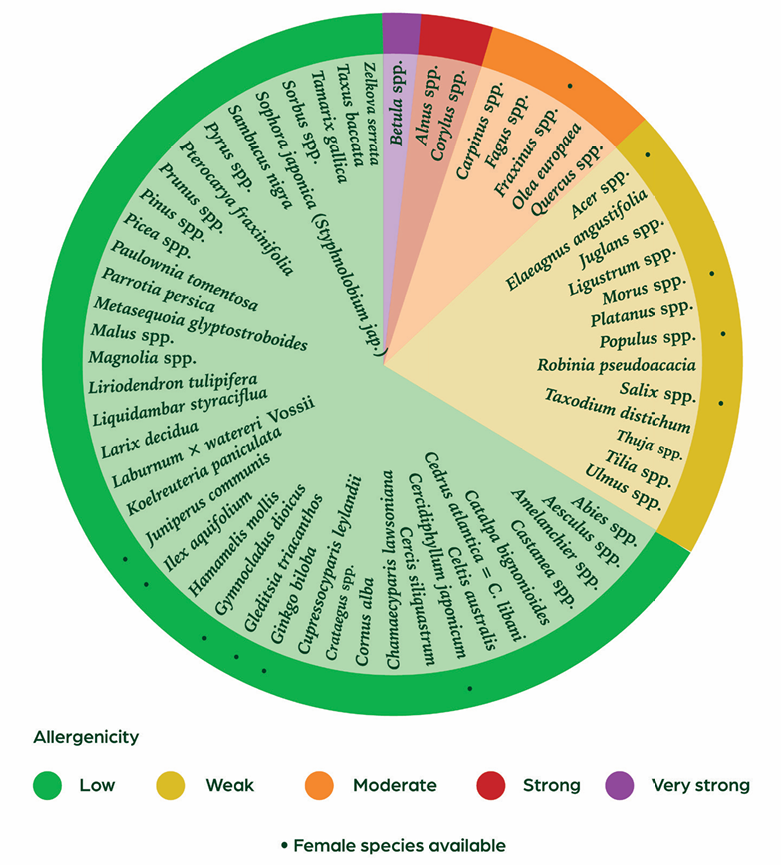
The Tree Compass for Allergenic Pollen. This is a simplified version of the compass. Source: https://www.trees.org.uk/News-Blog/Latest-News/Implementing-allergy-friendly-tree-planting
Read the full article at: https://www.trees.org.uk/News-Blog/Latest-News/Implementing-allergy-friendly-tree-planting
The Tree Compass was developed by Letty de Weger and Anne Overduin-de Vries (Leiden University Medical Center), Arnold van Vliet (Wageningen University & Research), Henry Kuppen, and Wendy Batenburg (Terra Nostra) as part of the KAPPA and GoHot research programs.
The Tree Compass (in Dutch) is available at www.lumc.nl/bomenkompas and is included in the Tree Table (www.bomentabel.nl) published by Wageningen University & Research.
Curious to learn more about urban greenery and the Tree Compass? Sign up for the free webinar on June 25 via https://www.gohot.eu/groen-in-de-stad