
The Effect of Fitness Level on Heat Acclimatization
July 2026
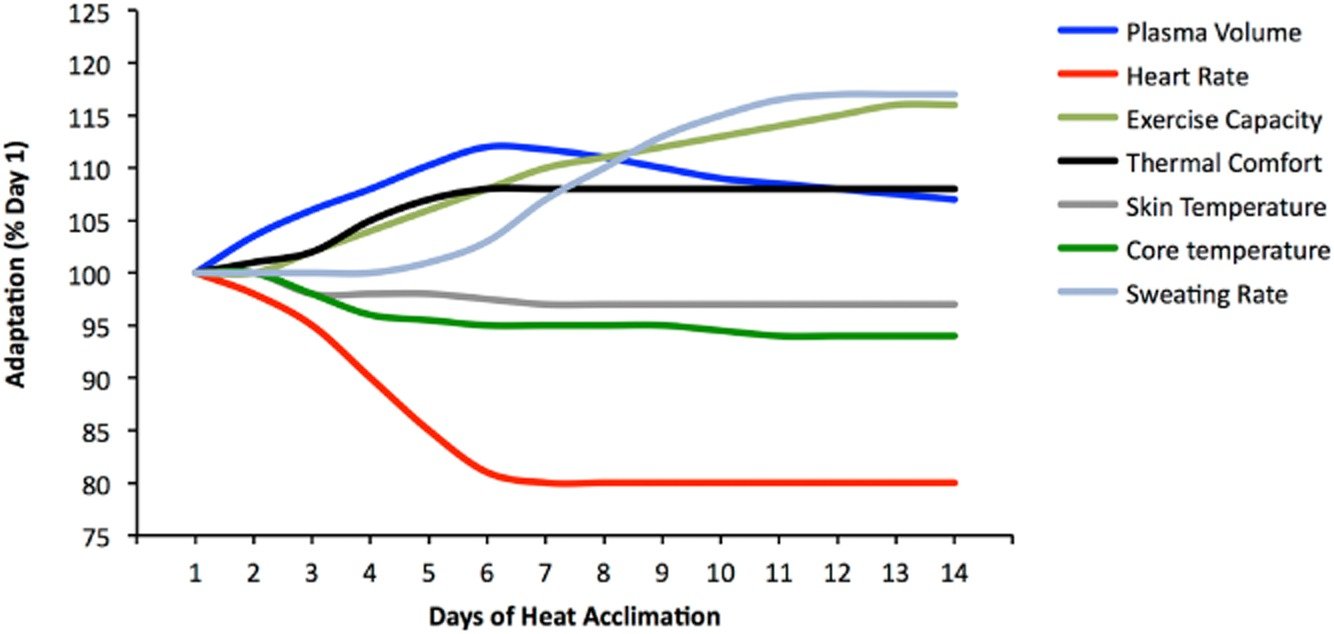
Heat acclimatization is the process by which the body adapts to working or exercising in a hot environment. Through repeated exposure to heat, the body learns to dissipate heat more effectively. The heart does not have to work as hard, the sweating response becomes more effective, and body temperature is better regulated. As a result, physical strain is reduced and the risk of heat-related health problems decreases.
The figure below shows the changes that occur during heat acclimatization.
Work Package 2.4 of the GoHot project investigated the role that fitness plays in this process. It is often assumed that fit people are already partially accustomed to heat and therefore acclimate more quickly. However, the literature shows that there is no convincing evidence to support this. High aerobic fitness (VO₂max) alone does not appear to be a good predictor of how quickly or to what extent a person adapts to heat.
Nevertheless, fit people are often found to have better heat tolerance. However, this seems to be primarily the result of the repeated heat stress they experience during regular training. In other words, it is not fitness itself, but rather frequent exposure to heat during exercise that appears to be the main explanation.
The review also shows that other factors influence heat acclimatization. For example, age, body size, and body composition all play a role. Older adults can still acclimatize well despite less efficient heat regulation, while children can also adapt to heat, but usually do so more slowly.
The main conclusion is that heat acclimatization is an effective way to improve heat tolerance in various groups of people. However, it is important that acclimatization protocols take individual characteristics—such as age, training background, and body type—into account. Based on current scientific knowledge, there is no consensus that fit people require shorter acclimatization periods than less fit people.
Read the short literature review (in English) here.